


 Story
Story
 Laura
Laura
 Mia
Mia
 Magda
Magda
 Luce
Luce
 Martina
 Mina
Mina
 Pearl district
 Irene
Irene
 Federica
 Frida
Frida
 Lucrezia
 Mirra
Mirra
 Ida
Ida
 Monica
 Isadora
 Unica
Unica
 Fedora
 Berenice

 Story
Story
 Vespucci
 Galileo
 Matteo
 Mattia
 Manfredi
 Brunelleschi
 Duccio
 By material
 Leather suitcases
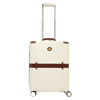 Hardside luggage
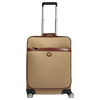 Softside luggage

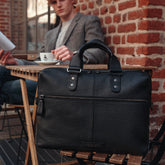


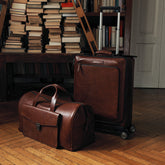

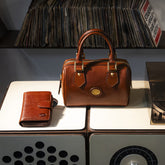


Tote, hobo, bucket bag, carry-all: behind every bag there is a name, and behind every name there is a shape born to meet a specific need. Knowing the names of bags is not an exercise in style for its own sake: it is the simplest way to find your bearings among the different models, to understand what sets one apart from another and to choose, with confidence, the one that will truly accompany your days.
In this guide we bring together the names of the most popular styles, their history and their characteristics, with some practical advice on how to recognize them at first glance.
Table of contents
- Why knowing the names of bags matters
- Women's bag names: the essential styles
- Men's bag names
- How to choose the right style for you
- Frequently asked questions about bag names
Why knowing the names of bags matters
Every bag style is the result of a long evolution. Some were born in the world of work, others from travel, others still from the elegance of special occasions. The name they carry often tells this story: the doctor bag, or physician's bag, recalls the traditional bags doctors carried on their house calls, the one-handle briefcase evokes the working days of businessmen away from home, while the travel bag conjures long train journeys and the transatlantic departures of an era when travelling called for large, sturdy luggage.
Shapes born with practical needs have thus become recognizable bag types, reinterpreted over the years to suit new ways of living without losing touch with their origins. Knowing these names means reading the history each shape holds. And it also means, more practically, knowing what to expect: capacity, carrying style, structure. An essential vocabulary that makes every choice simpler and more informed.
Women's bag names: the essential styles
The women's wardrobe counts dozens of styles, but some names come up more often than others, and they are worth knowing well.
Tote and shopper: everyday companions
The tote bag, or shopper, is the quintessential everyday bag: roomy, with two handles to carry on the shoulder or by hand, open at the top or closed with a zip. The name comes from the English to tote, to carry, and it says it all: a bag created to hold a great deal and adapt to different uses. Today the tote bag easily accompanies an entire day, holding documents, personal items and, in style designed for work, even a laptop. In leather it takes on a more elegant character, becoming a versatile bag that lets you move from the office to your free time without changing bag or style.
Hobo and shoulder bag: softness you can wear
The hobo is recognizable by its half-moon shape and soft, unstructured body, which naturally follows the lines of the figure when worn on the shoulder, settling gently against the hip.
The name has a curious history: in the United States of the late nineteenth century, hobos were the itinerant workers who crossed the country in search of employment, often riding freight trains, their few belongings gathered in a cloth bundle tied to a stick carried over the shoulder. It was that soft, gently slouching silhouette that fashion drew on, borrowing the name along with it. Today the hobo is a bag of relaxed elegance, informal yet refined, and one that shows vegetable-tanned leather at its very best.
The classic shoulder bag interprets the same gesture – carrying a bag on the shoulder – with a different attitude: more defined shapes, orderly lines and a generally more structured construction give it a more composed, formal character.
Bucket bag and carry-all: shapes that endure
The bucket bag, or “secchiello” as it is known in Italian, owes its name to its cylindrical silhouette, which recalls precisely that of a bucket: the vertical structure, usually completed by a drawstring closure, creates a generous interior while keeping the overall size relatively compact. It is precisely this balance of capacity, simplicity and softness that has made it a style capable of crossing eras and trends, moving effortlessly from more casual interpretations to more elegant versions.
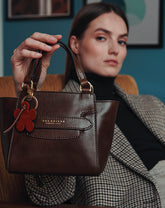
The carry-all, or “bauletto”, recalls the small luggage of days gone by: its defined base, compact body and twin handles give it an instantly recognizable silhouette, while the wide opening underlines its practical, capacious vocation. Born where the aesthetics of luggage meet those of the everyday bag, the carry-all still retains that balance of functionality and elegance.
Bucket bag and carry-all thus tell of two different ways of interpreting capacity: soft and informal the former, more defined and structured the latter. Two shapes that have become classics precisely because of their ability to evolve without losing their identity.
Crossbody, mini bag and pochette: the essentials close at hand
The crossbody bag was born of a simple and still very current need: to carry what you need while keeping your hands free. The long strap distributes the weight across the shoulder and lets the bag follow the body naturally, making it particularly practical. Compact yet functional, it is the choice of those who like to travel light, without giving up what the day requires. When the strap is long enough, the bag can be worn diagonally across the chest, bandolier-style, becoming a true crossbody: a way of wearing it that keeps it close to the body and leaves the hands free, guaranteeing freedom of movement and combining practicality with a naturally informal attitude.
The mini bag is its scaled-down version. Small yet a protagonist of the look, it is designed to hold only the indispensable, turning the need to carry just the essentials into a gesture of style.
The pochette, on the other hand, has a history tied to the evolution of women's fashion. Between the late eighteenth and early nineteenth centuries, as lighter, more fitted dresses took hold in Paris, the ample pockets hidden beneath skirts disappeared. Thus, the pochette was born: a miniature “external pocket” to hold in the hand or at the wrist. These small bags evolved into the pochette carried in the hand or under the arm, today associated above all with the most elegant occasions. Contemporary interpretations range from classic leather in black, brown and burgundy to silver leather versions, particularly well-suited to festive looks.
Men's bag names
The men's wardrobe has its own vocabulary too, made up of styles born above all for work and travel.
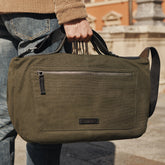
The work briefcase is the professional bag par excellence: an orderly structure, compartments for documents, often a flap with buckles. The one-handle briefcase is its most rigorous interpretation, with a single handle and a squared shape that calls to mind the businessmen of another era. The messenger, recognizable by its wide strap, horizontal shape and characteristic flap closure, began life as a functional bag for couriers, who needed quick access to the contents of their bag. Worn on the shoulder or across the body, it retains that practical vocation today, reinterpreted in a contemporary key. Roomy and functional, it has become an urban, work-ready bag with a more dynamic, informal attitude than the classic professional briefcase.
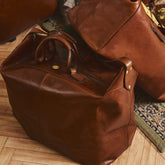
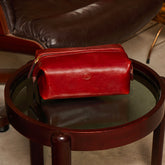
A place of its own goes to the doctor's bag, the physician's bag: a wide bellows opening, a generous structure and an old-world charm that make it a sought-after style today, well beyond the consulting room. Finally, the travel duffle, heir to the bags of travelers past: capacious, soft, designed for weekends away and short trips.
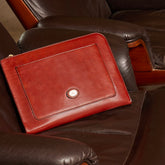
Alongside the backpack, the briefcase and the shoulder pouch, the men's pochette has established itself as a contemporary alternative, practical and elegant, that lets you carry smartphone, wallet, keys and earphones without filling out and misshaping the pockets of trousers and jackets. It can take the form of a flat envelope, held in the hand or under the arm, or come with a wrist strap: the so-called wristlet. Compared with a sporty pouch or a belt bag, the clean, geometric lines of the pochette add a more refined accent to the look. In leather it can complete a tailored suit with a relaxed, contemporary character; paired with a T-shirt, soft trousers and trainers, it takes on a more casual attitude.
How to choose the right style for you
Knowing the names of bags is the first step; the second is understanding which shape truly suits your life. Before choosing, it is worth asking yourself a few questions:
- What do I carry with me every day? Those who live with a laptop and documents will look for totes, work briefcases and one-handle briefcases; those who love the essentials will find the right measure in a crossbody or a mini bag.
- How do I prefer to carry it? By hand, on the shoulder or across the body: each way of carrying tells of a different way of moving.
- How much does structure matter? Rigid shapes, such as the carry-all and the doctor's bag, protect and keep things in order; soft ones, like the hobo, follow the body and grow more personal with use.
Whatever the style, the quality of the leather and of the construction remains the criterion that makes the difference: a well-made bag crosses the years improving, rather than wearing out.
Frequently asked questions about bag names
What is the difference between a tote and a shopper?
None to speak of: they are two names for the same style, the roomy double-handled bag. “Shopper” is the term most widely used in Italy, “tote” the international one.
What is the half-moon-shaped bag called?
It is the hobo: soft, worn on the shoulder, recognisable by its curved shape and relaxed profile.
What is a doctor's bag?
It is the bag inspired by those carried by the physicians of the past: a wide opening and a rigid, capacious structure. Today it is prized as a work and short-trip bag, for both men and women.
What is the most versatile bag for everyday use?
It depends on your habits, but a medium-sized crossbody and a tote remain the most versatile choices: the former for those who want their hands free, the latter for those who carry a lot with them.
Are a one-handle briefcase and a work briefcase the same thing?
They are close relatives, but not identical: the one-handle briefcase has a squared shape and a single handle, while the work briefcase is often softer, with a flap and a shoulder strap.
Conclusion
Bag names are much more than simple labels: they tell of origins, functions and ways of living. From the tote to the hobo, from the bucket bag to the doctor’s bag, every style has a precise personality, born of a real need and refined over time.
Knowing them helps you choose better, with the calm of those who do not chase trends but look for a lasting travelling companion. It is the same idea that guides every The Bridge creation: classic shapes, leather worked according to Tuscan tradition, and the conviction that when a bag is the right one, you can tell by the fact that you never stop carrying it.
There are no comments for this article yet.